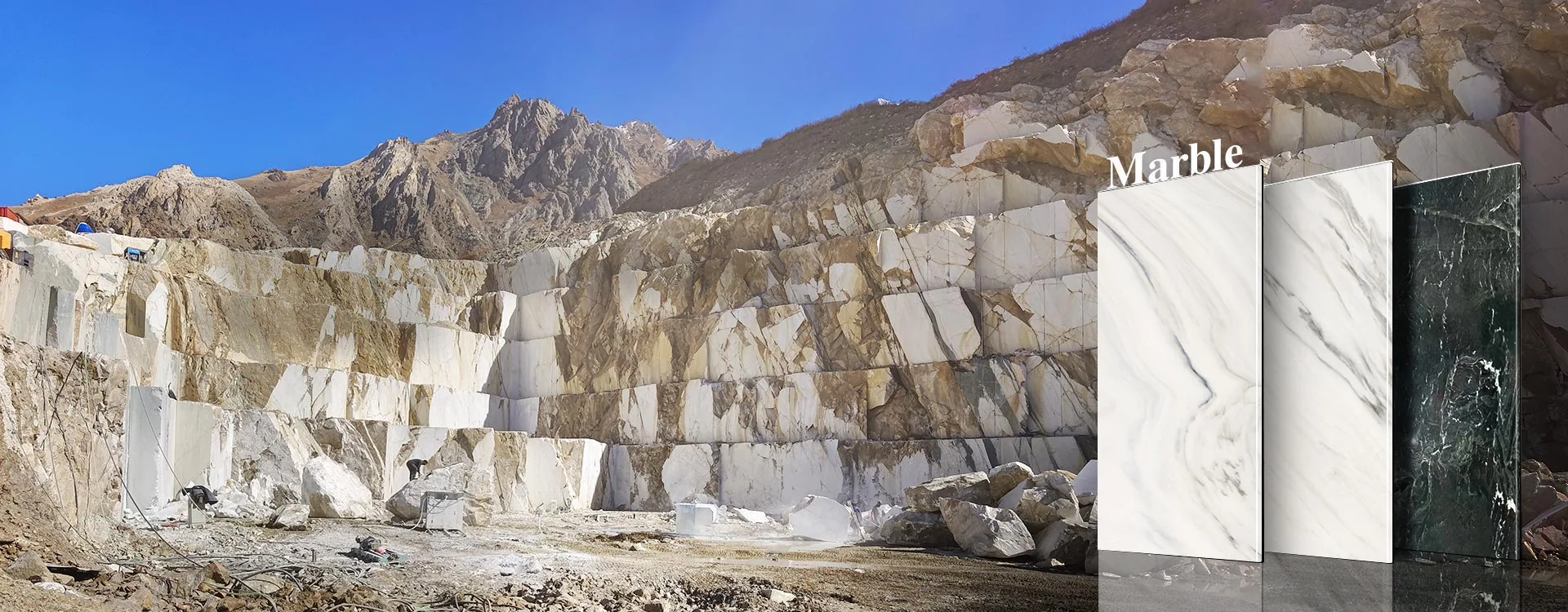
How granite slabs reach a fabricator
By the time a bundle of granite slabs is unloaded at a fabricator's yard, the material has passed through several hands: quarry, block trader, sawing plant, polishing line, slab yard and freight forwarder. Every handoff is a chance for a lot to be split, a bundle to be re-graded, or a colour to drift. Understanding that chain is the first practical step in buying granite slabs well.
The route usually looks like this:
- Block extraction and selection. Granite is quarried in large blocks; block colour and grain consistency decide how uniform the finished slabs will be.
- Sawing. Gang saws or multi-wire saws slice blocks into slabs, typically 20 mm or 30 mm nominal thickness.
- Resin and finishing. Many granites are resin-treated before polishing. Finishes include polished, honed, flamed, brushed, bush-hammered and leathered.
- Grading and yard storage. Slabs are graded, photographed and numbered, then stored vertically on A-frames.
- Selection and packing. Bundles are selected, then packed in fumigated wooden crates or A-frames with foam, wrap and strapping.
- Shipping and clearance. Container loading, ocean freight, destination clearance and inland delivery.
When that chain is fragmented, the risk sits with the buyer. Many importers therefore work with a stone exporter that holds the commercial relationship and coordinates processing partners, rather than buying blind from a single mill. Marble Supply Co., the export brand of PFM Imp. & Exp. Co., Ltd., is a Guangzhou-based trading company established in 2008, with a showroom roughly 25 minutes from the airport and partner fabrication in Yunfu and Shuitou, as described on the company's website. Ask the exporter how selection, inspection, and documentation are coordinated, while cutting and polishing happen inside China's main stone-processing clusters.
Choosing a granite supplier (checklist) for granite slabs
Most sourcing problems trace back to supplier selection, not to the shipment itself. When comparing granite suppliers, treat the following as a shortlist of questions you want answered in writing before any deposit moves.
| Check | Why it matters |
|---|---|
| Quarry and block access | Determines consistency between bundles and whether a repeat order can be matched months later. |
| Slab formats and thickness | 20 mm versus 30 mm, standard versus jumbo — this drives yield and effective cost per finished square metre. |
| Finishing range | Polished, honed, flamed, brushed, leathered. Mixed finishes on one order complicate quality control. |
| Inspection discipline | Photo and video records, with reject criteria agreed in writing before shipment. |
| Fabrication coordination | Can the supplier work to shop drawings for countertops, stairs, cladding and mouldings? |
| Packing and port logistics | Fumigated bundles, container stuffing photos, loading at Guangzhou or Shenzhen. |
Cost is driven by block availability and quarry yield, slab thickness, finish type, slab format, resin treatment, edge profiling, packing, freight and order timing. A cheaper slab that yields 60% usable area is often more expensive than a better-graded lot that yields 85%. Ask for the yield assumption, not just the rate.
Track record is a useful filter. A supplier's market mix tells you which standards they are used to meeting — Marble Supply Co.'s business is roughly 40% North America and 27.6% Middle East, with references including a 2025 New York 15-storey high-rise hotel facade, a 2025 Dubai luxury private villa, a 2025 Central Asian royal wedding hall, a 2024 Qatar modern luxury villa, a 2019 Palestine private palace villa, a 2021 Tajikistan luxury palace and the 2016 Hotel Bachaumont Paris. The company exhibits at Marmomac, supplies Tasso White marble through a Tajikistan quarry partnership, and states certificates available upon request. Importers comparing granite and marble slab suppliers should weigh this kind of evidence alongside sample quality.
Slab inspection: what to check on granite slabs
Inspection is where a good purchase becomes a claim. Whether you inspect on site or by live video, work through the same sequence every time.
- Lighting. Inspect under raking light, not flat overhead light. Dull patches and resin-filled cracks hide in soft light.
- Surface. Look for pinholes, fissures, scratches, uneven polish and colour patches within a single slab.
- Consistency. Compare slabs across the whole bundle, not just the top few.
- Thickness. Measure with calipers at several points per slab; nominal 20 mm or 30 mm carries a tolerance you should confirm in writing.
- Flatness and squareness. Warp and bow appear when slabs are dry-laid or stacked face to face.
- Backside. Check mesh or net backing, resin coverage and any sign of delamination.
- Edges. Chipped or bruised edges reduce usable area on cut-to-size work.
- Sequencing. Confirm slab numbering, bundle continuity and bookmatch sets if pattern flow matters to the design.
- Record. Photograph each bundle with a visible label and date so later disputes have evidence.
Agree reject criteria before inspection: maximum acceptable fissure length, permitted colour variance, thickness tolerance, and how many slabs may be rejected per bundle. A written specification turns a judgement call into a measurable one.
Working with granite fabricators
Granite fabricators work to tolerances, and the supplier-to-fabricator handoff is where most costly mistakes happen. A slab that is 2 mm thin, warped or mis-sequenced can throw off an entire countertop run or facade panel set.
- Shop drawings first. Slab layout should be approved before the bridge saw starts.
- Cut lists and yield plans. Match slab dimensions to the cut list so offcuts stay usable.
- Edge profiles and mitres. Confirm profile drawings, mitre joints and waterfall returns in advance.
- Sequencing for cladding. On facades, panel numbering and vein direction must be locked early.
- Sealing and jointing. Agree sealant type, joint width and expansion strategy for exterior work.
Where a project needs more than slabs, coordination across scopes saves time: countertops, vanity tops, stairs, columns, interior wall and floor marble, medallions, mosaics, fireplaces, fountains and facade material. For cladding, the facade fixing systems listed by the company are the Back Bolt System, Slotted Dry Hanging System, Glued Wall and Flooring System and Single Point Hanging Wall Cladding System — each has different fixing and panel-tolerance requirements that flow back into slab thickness and edge finishing — plus Architectural Waterjet Technology, a cutting and inlay technology.
Export packing and shipping (Guangzhou/Shenzhen ports)
Granite is heavy and brittle. Packing quality decides whether the slabs arrive as slabs.
- Bundles. Fumigated wooden crates or A-frames, with the timber treatment marked in line with destination requirements.
- Protection. Foam interleaving between faces, plastic wrap, corner protection and steel or heavy-duty plastic strapping.
- Identification. Bundle numbers matching the packing list, with dimensions, quantity and finish marked clearly.
- Weight planning. Granite runs roughly 2.7 tonnes per cubic metre — about 54 kg per square metre at 20 mm and 81 kg per square metre at 30 mm. Plan container payload before you plan the order quantity.
- Loading. Bundles loaded vertically and braced, weight distributed evenly, dunnage placed, container stuffing photographed.
- Ports and documents. Loading through Guangzhou or Shenzhen, with commercial invoice, packing list, bill of lading, certificate of origin and cargo insurance arranged according to the agreed Incoterm.
Build schedule buffer into the plan: production starts after deposit, and packing plus inland transport to port adds days before the vessel sails. Confirm the container loading date against your site programme rather than the other way around.
Business terms: MOQ 50 sqm, samples, 30/70 payment
Clear commercial terms remove most of the friction from a first order.
- MOQ. Usually 50 square metres. Mixed finishes, mixed thicknesses or multiple lots can raise the practical minimum.
- Samples. Free samples of marble, granite and mosaic; freight is paid by the buyer and refunded on order. Samples are typically ready in 1–3 days.
- Payment. 30% T/T advance with 70% before shipment.
- Response time. Replies usually within 24 hours.
Ask for the sample to be cut from the actual lot you will buy, not from stock photography, and keep a retained piece as your acceptance reference.
Buying granite slabs: next steps
Buying granite slabs is a supply-chain decision as much as a design one. Shortlist suppliers against quarry access, format range, inspection discipline and export experience; inspect against written criteria; coordinate fabricators early; and plan packing, weight and port logistics before the deposit. Do that, and the slabs that arrive will match the ones you approved.
Send your drawings, slab schedule and destination port to Request a Stone Quote and we will come back with availability, sample options and shipping terms.