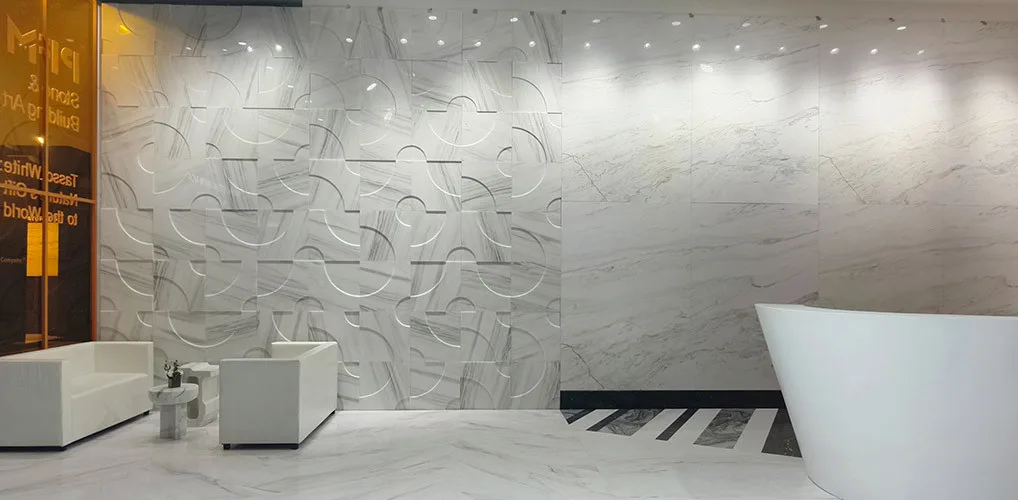
When a project calls for bathroom vanities, kitchen counters, or a full hospitality fit-out, the first real decision is material class. Cultured marble countertops and quarried natural stone can look strikingly similar in a showroom photo, yet they behave very differently once they are installed and in daily use. One is cast in a mold to a repeatable specification; the other is cut from a block that formed over millions of years. Getting the choice right at specification stage protects your budget, your maintenance schedule, and the finish level your client expects.
This guide explains what cultured marble actually is, how it compares with granite and marble, where each material earns its place, and what to prepare before you order natural stone vanity tops and countertops.
What cultured marble actually is
Cultured marble is an engineered cast polymer, not a quarried stone. The typical recipe blends finely ground limestone or marble with a polyester resin binder, pours that mix into a mold, and cures it under controlled conditions. A gel coat forms the visible surface, so the color, sheen, and any veining pattern are determined by the mold and the pigment formula rather than by geology.
Because the process is repeatable, mould-based production supports repeatable dimensions and appearance, within the manufacturer's tolerances. That is the defining property of the material. A vanity top, a shower pan, and a tub surround can all be produced with integrated components and no visible seams where the material flows into a single cast shape.
Natural stone sits on the other side of that line. Marble, granite, travertine, and onyx are quarried as blocks, then sawn into slabs, tiles, medallions, moldings, and stair treads. Every slab is unique. Fabricators can book-match or vein-match adjacent pieces, but they cannot promise that a replacement piece ordered years later will match what is already installed.
One distinction worth stating clearly: cultured marble is not the same as engineered quartz. Quartz surfaces use a much higher mineral content and a vibro-compaction process, producing a harder, denser slab. Cultured marble is softer, warmer to the touch, and typically cheaper to produce in volume — which is exactly why it dominates certain market segments.
Cultured marble vs natural stone (table: composition, look, durability, repairability, cost drivers)
The two materials diverge on five points that matter most during specification and after handover.
| Material aspect | Cultured marble (cast polymer) | Natural stone (marble & granite) |
|---|---|---|
| Composition | Ground limestone or marble blended with polyester resin, cast in molds, finished with a gel coat surface. | Solid quarried stone — marble, granite, travertine, onyx — sawn and finished by machine and hand. |
| Look | Uniform, repeatable color and pattern across every unit; molded edge profiles and integrated sinks; a limited pattern vocabulary. | Unique veining and movement per slab; book-matching and vein-matching possible; polished, honed, or brushed finishes. |
| Durability | Non-porous surface resists water and staining; the gel coat can scratch, dull, or craze under heat and abrasives. | Hard, heat-resistant, long service life; marble is softer and more etch-prone than granite; many stones benefit from sealing. |
| Repairability | Light scratches and dull patches can be buffed out; deep chips are filled with color-matched compound, and a damaged piece is often simply replaced. | Chips and cracks can be filled, sanded, and re-polished by a stone fabricator; slabs can be refinished in place. Replacement pieces may not match the original batch. |
| Cost drivers | Mold and tooling cost spread across volume, resin and filler prices, and how much repetition the project allows. | Block availability and slab rarity, quarrying and freight, cutting and edge fabrication labor, thickness, and installation complexity. |
Notice that neither column lists a price. On a project, the deciding factor is usually volume and repetition: cast polymer rewards identical units, while natural stone rewards a design where variation is the point. Template complexity, edge profile, cutouts, and installation access all shift the numbers further.
Where cultured marble makes sense
Cultured marble performs best where consistency and turnover cost matter more than geological character. Rental apartments, student housing, multi-family developments, budget-tier hotel bathrooms, and spec homes all share the same pressures: many identical wet areas, tight cleaning schedules, and a maintenance team that needs a predictable replacement path.
Key advantages in those settings:
- Uniform appearance helps a replacement top blend in — subject to continued product availability, batch, and aging of the installed piece.
- A non-porous surface that shrugs off soap scum, shampoo, and everyday spills without sealing.
- Integrated sinks, backsplashes, and shower receptors that eliminate seams where mold and grime collect.
- Simple, non-abrasive cleaning with mild soap and water — a real benefit when housekeeping staff rotate.
Cultured marble countertops in rental units and mid-market housing
For a 200-unit building, the specification is less about one beautiful bathroom than about the twenty-fifth replacement five years from now. Cultured marble countertops keep that future repair simple: the same mold, the same color code, the same edge profile — while the product remains in production. Edges are molded rather than fabricated, so there are no exposed seams to fail, and standard rectangular tops can be ordered in batches against a unit schedule.
The trade-off is honest and worth stating to an owner: the gel coat is a finish layer, not solid stone. Abrasive cleaners, scouring pads, hot pans set directly on the surface, and harsh solvents will all shorten its life. In tenant-occupied units, that means the material should be matched to a cleaning protocol you are confident will actually be followed.
Where natural stone is the right call
When the project is meant to signal permanence, natural stone is difficult to substitute. Lobbies, reception desks, feature walls, high-end residential kitchens and baths, facade cladding, staircases, columns, and fireplaces all read differently in solid quarried material — the depth of a polished marble surface cannot be replicated by a gel coat.
Our own references sit in that tier: a 15-story high-rise hotel facade delivered in New York in 2025, a luxury private villa in Dubai in 2025, a Central Asian royal wedding hall in 2025, a modern luxury villa in Qatar in 2024, a private palace villa in Palestine in 2019, a luxury palace in Tajikistan in 2021, and the Hotel Bachaumont in Paris in 2016. Marble Supply Co. (PFM Imp. & Exp. Co., Ltd.) works from a Guangzhou showroom with partner fabrication in Yunfu and Shuitou (as described on the company's website). The company's website lists marble and granite tiles, medallions, mosaics, agate slabs, moldings, stairs, railings, fireplaces, and fountains, and covering scope items from facade material and interior wall and floor marble to columns, vanities, and countertops.
Where facades are involved, four fixing and bonding systems are used depending on substrate, stone thickness, and exposure — Back Bolt System, Slotted Dry Hanging System, Glued Wall and Flooring System, and Single Point Hanging Wall Cladding System — alongside Architectural Waterjet Technology, a fabrication technology for cutting and inlay. Tasso White marble is supplied through a Tajikistan quarry partnership, and the company exhibits at Marmomac.
Cleaning and care differences
Maintenance is where the two materials feel most different in daily operation.
Cultured marble cleaning
Warm water with a mild liquid soap or a non-abrasive bathroom cleaner is sufficient. Wipe with a soft cloth or sponge, then rinse. Avoid abrasive powders and scouring pads, which dull the gel coat; avoid acidic cleaners and solvents, which can etch or cloud the surface; and wipe up hair dye, nail polish remover, and similar staining products promptly.
Cultured marble care and maintenance
No sealing is required, because the surface is non-porous. Periodic care is mostly cosmetic: light scratches and wear patterns can be buffed out with a non-abrasive polishing compound, and color-matched filler handles small chips. Always use a trivet or mat under hot cookware, since cast polymer has limited heat tolerance compared with stone.
Natural stone cleaning and care
Marble and granite prefer pH-neutral stone cleaners. On marble, acids — vinegar, citrus, wine, and many general-purpose bathroom sprays — will etch the surface and leave dull marks, and honed finishes hide that damage better than polished ones. Granite is more resistant to etching but still benefits from sealing. Blot spills rather than wiping them across the surface, reseal countertops on the schedule the stone and finish require, and use trivets for hot items on marble.
Cultured marble countertops vs granite: choosing by project type
A short decision rule covers most projects. If you are fitting many similar bathrooms with a defined budget and a long replacement horizon, cultured marble countertops are usually the practical answer, and cultured marble vs granite comparisons tend to break toward the cast polymer on consistency and maintenance cost. If the room is a signature space, a facade, a lobby, or a residence where the client is buying uniqueness and longevity, natural granite or marble is the correct specification. Mixed projects work too: stone in the public areas, cast polymer in the service and back-of-house bathrooms.
Ordering natural stone vanity tops and countertops
Natural stone countertops are fabricated to a template, not pulled from a shelf, so the ordering process rewards preparation. Send drawings or field dimensions, the material and finish you want, edge profile details, sink and faucet cutout information, backsplash height, and quantities broken down by material. If the stone has not been selected yet, a sample review should come first.
Working terms at Marble Supply Co. are straightforward:
- MOQ is usually 50 square meters.
- Free samples of marble, granite, and mosaic; freight is paid by the buyer and refunded on order.
- Samples are ready in 1–3 days.
- Payment is 30% T/T advance with 70% before shipment.
- Shipping ports are Guangzhou and Shenzhen.
- Enquiries are usually answered within 24 hours.
- Certificates available upon request.
The Guangzhou showroom sits about 25 minutes from the airport for buyers who want to review slabs in person, and partner fabrication in Yunfu and Shuitou handles cutting, edge work, and custom pieces.
In short, cultured marble countertops win on repetition, consistency, and low-fuss maintenance, while natural stone wins on character, permanence, and the impression a prestige space is meant to make. Choosing between them is a specification decision, not a quality judgment — and the right answer usually follows the project tier, the unit count, and who will clean the surface two years from now. Tell us the application and quantities, and we will point you to the material class that fits.