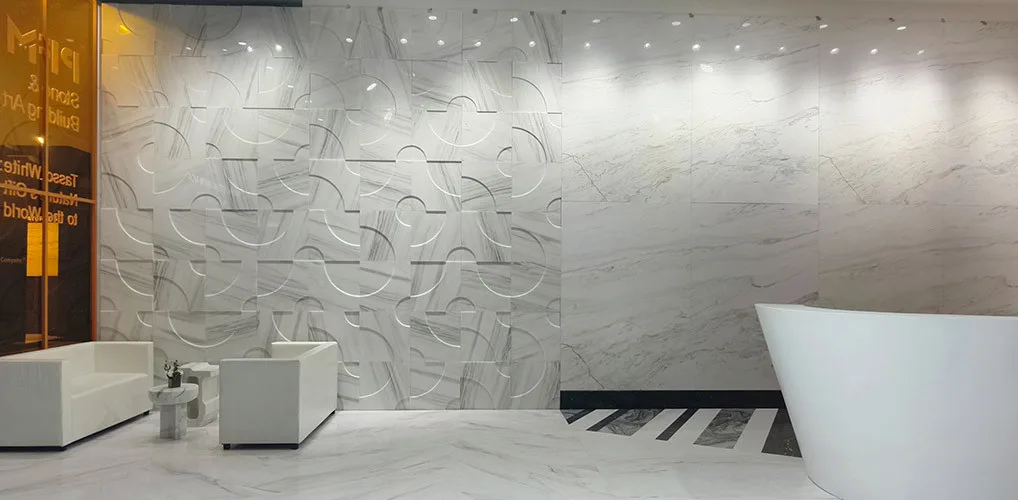
What makes onyx different from marble
Onyx and marble sit side by side in most stone showrooms, polished to the same mirror finish. Below the surface they are two different materials, and understanding the difference is what keeps a project out of trouble.
The clearest dividing line is translucency. Light passes through onyx. Depending on the thickness of the slab and how it was cut, a backlit onyx panel glows from within — you see the stone's own layers light up rather than a reflection sitting on the face. Marble is opaque. Light stops at the surface, which is exactly why it works for flooring, cladding, and counters where a solid, stable face is the goal.
Onyx forms from layered mineral deposits, generally calcium carbonate laid down in bands over long periods in caves and around mineral springs. That layered origin shows up in the finished stone as banding and striation — parallel or softly wavy ribbons of color running across the slab. Marble forms differently: limestone recrystallizes under heat and pressure, producing the flowing mineral veins the stone is known for. Those two formation stories explain the two pattern languages. Onyx is about bands and horizontal movement. Marble is about veins branching across the face.
The trade-off for onyx's glow is that it is the more delicate material. It is softer than marble on the Mohs scale, more porous, and more expensive per square foot. None of that makes it a worse stone; it makes it a stone with a narrower job description. Use it where light and pattern do the work. Use marble where the surface has to take punishment.
You will often see onyx sold as "onyx marble." That is a trade name rather than a geological one. It reflects the fact that the two stones are finished, sold, and installed by the same trades — not that they behave the same way in service.
Onyx vs marble, head to head
Five differences decide most specifications. Read them as a set, because no single line tells the whole story.
- Translucency. Onyx is translucent and looks stunning when backlit. Marble is opaque, and backlighting it accomplishes nothing.
- Hardness. Marble rates 3–4 on the Mohs scale. Onyx rates 2.5–3, which makes it the softer stone.
- Porosity. Onyx is more porous than marble and needs more frequent sealing.
- Pattern. Onyx has banded patterns. Marble has veining.
- Price. Onyx is more expensive than marble.
Read as a checklist, that comparison favors marble on nearly every practical measure. That is an honest reading, and it is the reason onyx is a specialty material rather than a default one. What the list cannot capture is the single category onyx wins outright, and it is often the category that decides the project: translucency. There is no marble that glows.
Where onyx earns its price
Onyx performs best when it is lit from behind and treated as a feature rather than a working surface. In practice that means vertical applications, decorative elements, and places where the material is seen rather than used.
Backlit feature walls
This is the classic application. A large onyx wall, backlit with an even LED field, turns the stone's banding into the graphic itself. The panel becomes a light source that happens to be made of stone, and the surrounding room can stay quiet while it carries the space.
Bar fronts and bar niches
A lit onyx bar front gives a restaurant or hotel bar its glow without relying on signage or neon. Bar niches and back-bar shelving lined in onyx work especially well, because a small backlit panel behind bottles reads clearly at eye level and stays out of the wear path.
Reception areas
A feature wall behind the reception desk or an onyx desk front can create a strong first impression. A backlit onyx panel there does the work of a brand statement, and it holds up better than a countertop would because nobody sets down keys and coffee cups on it all day.
Accent walls and lighting effects
In lobbies and lounges, onyx supports a range of lighting treatments: even backlighting for a full-wall glow, edge lighting for a cooler halo along the panel perimeter, and dimmable fixtures so the effect can shift from daytime brightness to evening mood. Each approach reads differently against the same slab, which is one more reason to review samples under the light you plan to use.
One caution matters more than any of these recommendations: onyx is not recommended for daily-use countertops. At 2.5–3 on the Mohs scale and more porous than marble, it is too soft and too absorbent for that duty. Kitchen counters, bathroom vanities, and busy bar tops will scratch, etch, and stain. For those surfaces, marble is the better choice. Keep onyx vertical and decorative and it will look remarkable for years. Put it under a knife and a hot pan and it will not.
Fabrication and care
Onyx's softness shapes everything about how it is cut, handled, sealed, and maintained. Plan for it and the material behaves. Ignore it and the damage shows up quickly.
Cutting and handling
At 2.5–3 on the Mohs scale, onyx marks more easily than marble during fabrication. Shops should use sharp tooling and controlled feed rates, support slabs fully on the worktable, and move finished pieces with the same care you would give a fragile glass panel. Edge profiles and cutouts take longer to execute cleanly, so build that time into the schedule.
Book-matching
Because onyx reads in bands and layers, it is a natural candidate for book-matching — mirroring consecutive slabs against each other to create a symmetrical pattern across a wall or a pair of panels. The result is a repeated, almost architectural graphic rather than a random one. Book-matching works best when the layout is planned before any cuts are made, with joint positions, backlighting layout, and slab sequence confirmed together. On a backlit wall, the joint plan and the lighting plan need to agree; a light field that crosses a mismatched seam will reveal it.
Sealing
Onyx is more porous than marble, so it needs more frequent sealing. A penetrating sealer applied at fabrication is the starting point, followed by reapplication on a schedule based on how the surface is used and cleaned. Vertical decorative panels in a lobby will need less attention than a surface that gets touched and wiped daily.
Cleaning and chemicals
Use a pH-neutral stone cleaner and a soft cloth. Keep onyx away from harsh chemicals — acidic cleaners, bleach, abrasive powders, and ammonia-based products can dull the finish and break down the sealer. Wipe spills promptly, particularly wine, citrus, oils, and anything with dye in it, and never let a spill sit on the stone overnight.
Sourcing onyx for a project
Onyx is part of the regular product range at PFM Imp. & Exp. Co., Ltd. — the Guangzhou-based natural stone company (brand PFMstone) behind Marble Supply Co. Alongside marble, granite, limestone, waterjet marble, mosaic, fireplace, fountain, and carving sculpture, the material gallery includes a dedicated Onyx Gallery and a Semi-precious Gallery.
Request samples before you make a final selection. Onyx varies from bundle to bundle, and a photograph rarely predicts how a specific slab will look under light. Free samples are ready in 1–3 days. Freight is charged on sample shipments and refunded when you place an order.
Once the material direction is set, confirm slab selection and finish directly. Finish matters more than usual with onyx, because polish, honing, and slab thickness all change how light moves through the stone — and a finish that looks right in daylight may read differently under backlighting.
Typical project flow:
- Share drawings and the scope of work.
- Receive a material and budget proposal.
- Review shop drawings and fabrication, with quality control through production.
- Export packing and shipment from Guangzhou or Shenzhen ports.
Payment terms are 30% T/T in advance, 70% before shipment. The showroom and export office are in Guangzhou City, roughly 25 minutes from the airport, with factories in Yunfu and Shuitou. To request samples or pricing, contact us with your drawings, quantities, and target schedule.